
How We Use ZeroRank and Claude to Improve AI Visibility for Local Businesses
Ask ChatGPT or Gemini for “the best water damage company near me” and you'll get two or three names. Not ten blue links. Two or three names. If your business isn't one of them, that customer may never know you exist.
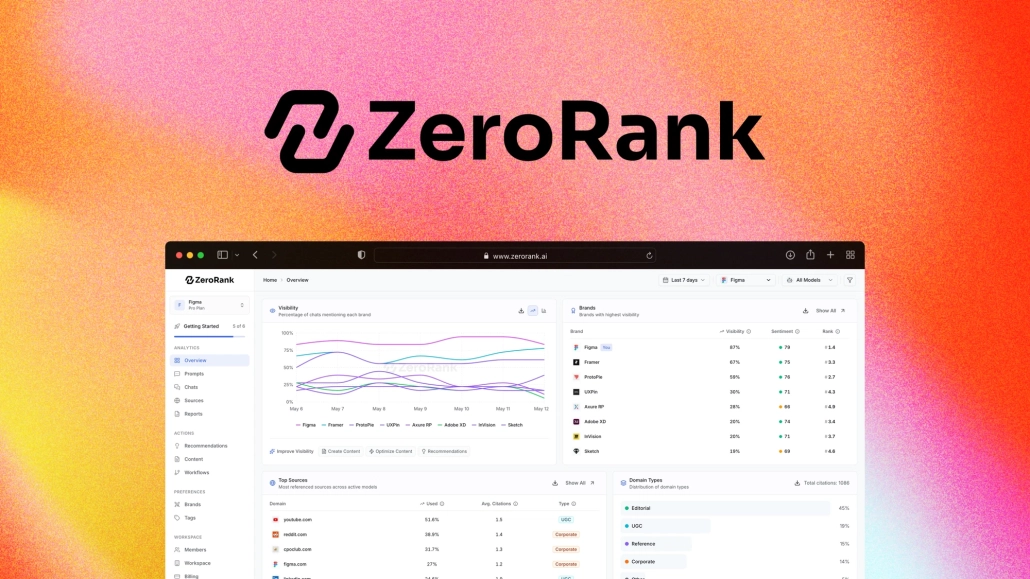
That's the problem we've been working on for our clients, and the most useful tool we've found for it is ZeroRank. ZeroRank shows you exactly which AI answers mention your business, which ones mention your competitors instead, and which websites the AI tools are reading to form their opinion. When we connect it to Claude, we can go one step further: analyze every tracked answer, figure out why a client is missing, and build a specific list of fixes for their website, Google Business Profile and wider online presence.
So is ZeroRank effective for AI optimization? In our experience, yes, because it turns AI visibility from guesswork into something you can measure, diagnose and track over time. Below, I'll walk through how it works, how we use it with Claude, and four real examples from local service businesses we work with (anonymized by industry).
Why does AI visibility matter for a local business now?
A year ago, most business owners could safely ignore AI search. That's no longer true.
- 45% of consumers now use AI tools to find a local business, up from just 6% the year before, according to BrightLocal's 2026 Local Consumer Review Survey (source). [Gary: link to BrightLocal's original report if preferred.]
- Yext's 2026 survey of U.S. adults found 47% had used an AI tool to find a local business in the past month (Yext).
- At the same time, 75% of U.S. consumers who used AI to find a local business checked Google or Maps before contacting them (BrightLocal, July 2026, via eMarketer).
That last number is important. AI isn't replacing local SEO. It's sitting on top of it. The AI answer gets you on the shortlist, and then your Google Business Profile, reviews and website close the deal. You need both.
What is ZeroRank, in plain English?
Think of ZeroRank as a rank tracker for AI answers.
With traditional SEO, you track where you rank on Google for a keyword. With ZeroRank, you track prompts — the actual questions customers type into AI tools, like “Who's the best basement waterproofing company in Toronto?” ZeroRank runs those prompts on a schedule across multiple AI models (ChatGPT, Gemini, Perplexity, Claude and others) and records:
- Visibility: the percentage of answers that mention your business
- Mentions and average position: how often you're named and where you appear in the list
- Sentiment: whether the AI describes you positively, neutrally or negatively
- Competitors: who gets named when you don't
- Sources: which websites the AI cited when it built the answer
The sources piece is the part most business owners have never seen before, and it's often where the real fix is hiding.

Why connect ZeroRank to Claude?
ZeroRank's dashboard is good on its own. But ZeroRank also offers an MCP connection, which lets an AI assistant like Claude read the data directly. That changes how much analysis we can realistically do for each client.
Instead of clicking through dashboards, we can ask Claude questions like:
- “Which prompts name two or more competitors but not our client?”
- “Which websites does the AI cite most often for these prompts, and is our client's site one of them?”
- “Pull the actual answers where our client has low sentiment. What is the AI saying?”
- “Compare those answers against the client's service pages and Google Business Profile. What's missing?”
Claude reads the prompts, the full answer text, the cited sources and the competitor data, then lines it up against what's actually on the client's website. The output is a prioritized fix list: pages to create, sections to rewrite, FAQs to add, profiles to update, and third-party sites where the business needs a stronger presence.
We review every recommendation before anything changes. The tools do the heavy lifting on analysis; the strategy and judgment still come from us.

What does this look like for real local businesses?
Here are four examples from home improvement and contractor clients we track in ZeroRank. Figures come from a 90-day window ending October 2026. “Visibility” means the share of tracked AI answers that mention the business.
Example 1: A waterproofing contractor that's already winning (and needs to stay there)
A building restoration and waterproofing contractor in the Greater Toronto Area appears in 31% of tracked AI answers. The next closest competitor appears in 17%. Everyone else is at 3% or less.
The lesson here isn't “do nothing.” It's knowing exactly which prompts you own and which ones you don't. ZeroRank shows us the specific questions where competitors still get named instead, so we can focus effort there rather than rewriting pages that are already working.
Example 2: A restoration company that gets named but doesn't get cited
A water damage restoration company in the GTA leads its competitive set, appearing in 14% of tracked answers compared to 7% for the next competitor. Good news.
But when we looked at the sources, the picture changed. The most-cited websites in those answers were government and industry sites — the U.S. EPA (cited in 32% of answers), the IICRC certification body (19%) and canada.ca (13%) — along with several competitors' websites. Our client's own site wasn't in the top 15 sources.
In other words, the AI knows the business exists, but when it explains mould, flooding or drying, it's reading someone else's content. Being named and being cited are two different wins, and they need different fixes. For this client, that means building answer-ready educational content on the exact questions customers ask (what to do after a flood, when mould becomes dangerous, how long drying takes) so the AI has a reason to quote the client's site, not just list the name.
Example 3: A design-build contractor with a sentiment problem
A design-build contractor in Toronto that builds garden and laneway suites is essentially tied for first in mentions: 13% visibility versus 14% for the leading competitor. On visibility alone, that looks fine.
The issue showed up in sentiment. ZeroRank scored how AI tools described the business at 62 out of 100, while several competitors scored around 80. Same visibility, but a weaker recommendation.
The sources explained a lot. The most-cited sites for these prompts were Houzz, the City of Toronto website, Facebook, YouTube and Reddit — third-party platforms, not company websites. AI tools are forming their opinion of this contractor from what other people say about them online.
This is where Claude earns its keep. It can pull the actual AI answers, word for word, so we can see exactly what's dragging the tone down, then map that back to the business's reviews, Houzz profile and social presence. The fix here is mostly off the website: reputation, third-party profiles, and making sure the business's strengths show up where the AI is actually looking.
Example 4: A California remodeler that's invisible, and why
A remodeling and ADU (accessory dwelling unit) contractor in the San Francisco Bay Area wasn't mentioned in any of its tracked AI answers. Two competitors each appeared in 13%.
The sources told us why. The most-cited sites were California's Department of Housing and Community Development (cited in 53% of answers) and the Contractors State License Board (40%), plus local county permitting pages. When people ask AI about building an ADU, the AI leans heavily on permitting rules, licensing requirements and local regulations.
That's a clear content roadmap. A contractor that clearly explains local ADU rules, permit steps, timelines and licensing — in plain English, on well-structured pages — gives AI tools something worth citing. Without that content, there's simply nothing on the site that answers the questions customers are asking. (This workspace has a smaller set of tracked answers than the others, so we treat it as an early read, not a final verdict.)

What patterns have we noticed across clients?
A few things keep showing up across every industry we track:
- AI tools lean on authority sources. Government sites, certification bodies and industry associations get cited constantly. Your content needs to be accurate enough to sit alongside them, and it helps to reference them where relevant.
- Third-party platforms shape the AI's opinion. Houzz, Facebook, YouTube, Reddit, HomeStars and review sites all feed the answer. Your website is only part of the story.
- Being named isn't the same as being cited. You can show up in the answer without your website being the source. Both matter.
- Visibility without good sentiment is a half-win. If the AI mentions you lukewarmly, the customer still picks someone else.
- The fixes are mostly local SEO fundamentals. Clear service pages, location content, FAQs, schema, a well-maintained Google Business Profile, steady reviews and real authority signals. AI optimization is the evolution of local SEO, not a replacement for it.
How should a local business get started with AI optimization?
You don't need a tool to start. Here's a simple version you can do this week:
- Ask the AI yourself. Type five questions a real customer would ask into ChatGPT and Gemini. Write down who gets named.
- Look at the sources. Where the tool shows citations, note which websites it's reading.
- Check your own pages. Does your website clearly answer those same questions, with your services and service area spelled out?
- Tighten your Google Business Profile. Categories, services, photos and reviews all feed both Maps and AI answers.
- Show up where the AI is looking. If it keeps citing a directory or platform where you have a thin profile (or no profile), fix that.
The limitation of doing it by hand is consistency. AI answers change from day to day, and five manual checks won't tell you whether a fix actually worked. That's the gap a tool like ZeroRank fills: the same prompts, on the same models, on a schedule, so you can see before and after.

Frequently asked questions
What is AI optimization for a local business? It's the work of making your business easier for AI tools like ChatGPT, Gemini and Google's AI Overviews to understand, trust and recommend. It builds on local SEO: clear website content, a strong Google Business Profile, reviews, schema, citations and authority signals.
Can ZeroRank guarantee my business will be recommended by ChatGPT? No tool can. AI answers vary and change over time. What ZeroRank does is measure where you stand, show why you're missing, and track whether your changes are moving the numbers.
Do I still need Google Business Profile if customers use AI? Yes. BrightLocal found that three out of four people who used AI to find a local business checked Google or Maps before contacting them. Your profile is often where the decision gets made.
How long does it take to improve AI visibility? It depends on the starting point and the competition. ZeroRank's own case studies point to most brands seeing movement within about 90 days. Some fixes, like adding a missing FAQ or correcting a profile, can be done in an afternoon.
The bottom line
AI search is already shaping which local businesses get the call. ZeroRank gives us something we didn't have before: a clear view of where our clients show up in AI answers, where they don't, and what the AI is reading when it decides. Connecting it to Claude lets us turn that data into specific, prioritized fixes instead of vague advice.
At 3Bug Media, this is now part of how we run local SEO and AI optimization for our clients, alongside Google Business Profile management, online advertising and ongoing strategy. All the work is handled in-house. There are no contracts and no setup fees, because we'd rather earn your business every month.
If you want to know how your business shows up in AI answers today, request a free Local SEO + AI Visibility Audit. You'll get a detailed PDF report with a prioritized roadmap of improvements. It's yours to keep, whether you do the work yourself, hand it to someone else or have us take care of it.


Gary
Latest posts by Gary (see all)
- How We Use ZeroRank and Claude to Improve AI Visibility for Local Businesses - October 6, 2026
- 5 Ways Local Businesses Can Use QR Codes Today - July 11, 2026
- What Happens If You Don't Claim Your Google Business Profile - July 11, 2026


